It’s Ohio

A caveat: a lot can happen between now and election day (November 6).

That said, I have done the math a few different ways, and if the presidential election goes the way I think it will, this will be fairly close, and hotly contested Ohio will be the deciding state.

Here’s how I think it happens: Obama carries the northeast, pretty much outright, and the west coast. With some of the upper midwest, he gets to 266 electoral votes, just shy of the 270 the winner will need. Romney carries the southeast, some of the midwest, the Plains and mountain states. That gets him to 254 electoral votes.

Ohio has a delegation of 18 electors. Whoever carries Ohio will win; I don’t believe either candidate can win without carrying Ohio.

So, if you want to know who will occupy the Oval Office starting in January 2013, keep your eyes on the Ohio polls.

In Flanders Fields

I ran into two old Marines yesterday, handing out red poppies for a donation to the Veterans of Foreign Wars. We talked for a few minutes, as I love to do with veterans, and they told me I was the first person in hours who’d known what the poppies represent.

It’s sad, really, but it’s the price we Americans pay for turning all our commemorative holidays into generic three-day weekends. More BBQ and beer, less appreciation.

In case you don’t know, there was a horrific series of battles on and around a Belgian plain during the First World War. Red poppies grow there naturally in abundance, creating the look of a field of blood where the fighting and death had taken place. This poem, which captures the spirit of the dead, was written soon after the first fighting there.

In Flanders Fields

by John McCrae, May 1915

In Flanders fields the poppies blow
Between the crosses, row on row,
That mark our place; and in the sky
The larks, still bravely singing, fly
Scarce heard amid the guns below.

We are the Dead. Short days ago
We lived, felt dawn, saw sunset glow,
Loved and were loved, and now we lie
In Flanders fields.

Take up our quarrel with the foe:
To you from failing hands we throw
The torch; be yours to hold it high.
If ye break faith with us who die
We shall not sleep, though poppies grow
In Flanders fields.

And that is what Memorial Day and the red poppies handed out by aging veterans commemorate.

True Stories: Ella and Marilyn

Yes, they knew each other.

Here’s the story:

“I owe Marilyn Monroe a real debt…it was because of her that I played the Mocambo, a very popular nightclub in the ’50s. She personally called the owner of the Mocambo, and told him she wanted me booked immediately, and if he would do it, she promised she would take a front table every night. She told him – and it was true, due to Marilyn’s superstar status – that the press would go wild. The owner said yes, and Marilyn was there, front table, every night. The press went overboard. After that, I never had to play a small jazz club again. She was an unusual woman – and ahead of her time and she didn’t know it.” – Ella Fitzgerald

How wonderful these two met. How wonderful Marilyn helped Ella broaden her audience. And how wonderful Ella remembered Marilyn and her kindness so fondly.

Why Even Bother?

People often ask why writing for popular films can be so bad.

I have a hypothesis. But first, let me say I love movies and find the writing in many films to be of very high quality. That said, there are many very popular films that induce audience groans at the silliness, dumbness, flatness and woodenness of their writing.

Let’s start by asking who goes to movies. According to MPAA data, males make up over half of the moviegoing audience. About 50% are under the age of 25. Therefore, the movie audience is more male and a lot younger than the general American population.

So let’s add some unscientific but recent personal experience with that demographic group.

In preparation for taking my son and his classmates to see The Avengers a few weeks ago, I asked my son about the characters I’d likely see in the picture and about the films they’d been in previously. I asked him specifically about Thor because I hadn’t seen that movie when it was released last year. My son’s synopsis (in its entirety) of the 115 minute Thor movie went something like this:

So, Thor’s a god, right? And he comes to earth because of something his brother did. And he meets that girl from Star Wars, who married Anakin, and she’s a doctor. And Thor’s all, like, “Hey, I can’t stay here on earth.” And she’s all, like, “Whatever.” But he tries to go back but can’t because of something his brother did. So he decides to stay. And also, he likes her. So, yeah, that’s it. It was good.

Consider what my teenaged son took from that script. Hardly a reason to put in extra effort, huh?

And as long as Hollywood answers to the purchasing power of an audience that skews young and male, we’re likely to continue getting movies that are looks first and writing second.

The Triumph of Light

San Francisco is a city that rewards looking closely, under the surface, behind the closed curtains and doors. It’s so closely associated with its shroud of fog for a reason. This is a mysterious city that defies easy characterization, much less caricature. San Francisco provides the only possible setting for America’s preeminent mystery book, The Maltese Falcon. And the city is mysterious in other ways as well: there are things here that are inexplicably quirky or bizarre, are not obvious, not easy to spot, hidden from view if you don’t know exactly where to look, or here one minute and gone the next.

Witness, if you will, The Triumph of Light, a story almost too good to be believed.

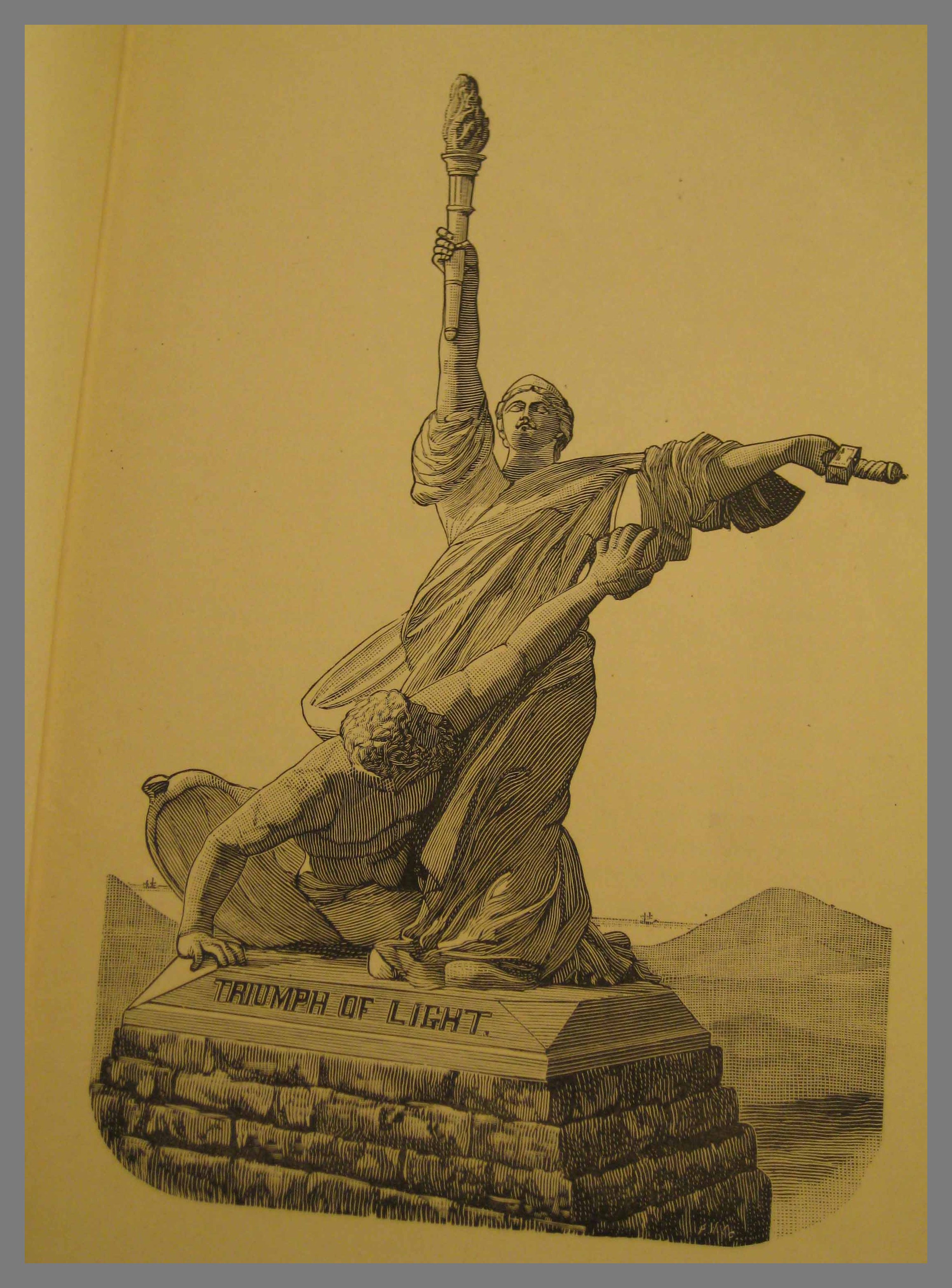
In the late 1880s, during the days when such monuments were erected, Adolph Sutro, a silver baron, philanthropist and former mayor who owned the hill at the precise geographic center of the city, decided to commission Belgian artist Atoine Wiertz to build an allegorical piece depicting the victory of liberty, depicted as a torch-carrying lady, over despotism, a cowering muscled hulk. And so it was completed, installed and dedicated on Thanksgiving Day, 1887. At the dedication ceremony, Sutro said: “May the light shine from the torch of the Goddess of Liberty to inspire our citizens to good and noble deeds for the benefit of mankind.”
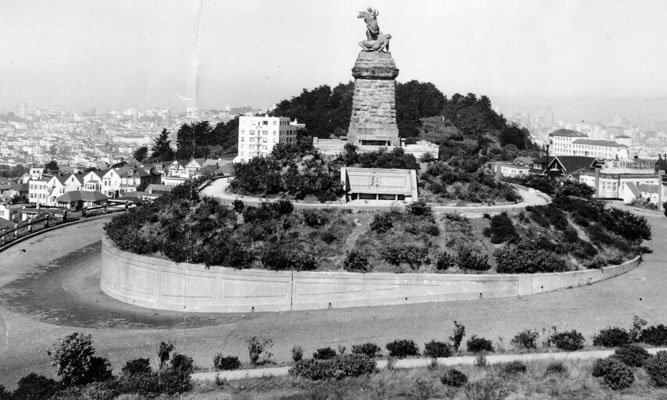
So, the statue stood, looking over the people of San Francisco, possibly guiding them toward good and noble deeds. And in many other places, that might have been the end of the story but, hey, this is San Francisco and we don’t roll that way.

Years passed, and people stopped thinking in the ways Sutro and others thought they ought. Monuments to liberty and other civic virtues were no longer objects of public affection and care. Ugly apartment blocks and condominiums were built around this statue’s site, blocking its commanding view and removing the piece from public view and consciousness. Fewer and fewer San Franciscans, as time passed, even knew of the monument’s existence.

There were natural forces at play too. As it turns out, statues need love and care. Their materials decay and degrade over time. The Triumph of Light was no exception. The San Francisco Arts Commission reported that the statue was in danger and there was serious talk about replacing it with a Bufano sculpture the city had in storage.

That was the near-final public record of the statue. And then, sometime in the 1950s, poof, The Triumph of Light simply disappeared. No one, not neighbors, not the city government, knows where. What’s left now is the base and the pedestal. Its inscription is worn down to virtually nothing.

Another San Francisco mystery.

Traveling With Kids

Nothing looks familiar, so the right stop comes as a surprise. Hadn’t you been watching? Did you read the map wrong, again? Not now. Pay attention.

Let’ go, for God’s sake.

There’s so much baggage to get together. Their snacks are spread out all over the place. This is stuck to the seat now. Where’s his shoe? The other one.

Do you have the tickets? No, you didn’t give them to me. Well, I sure don’t have them.

I don’t care if he doesn’t want to leave. This is our stop. If we miss it, we’ll miss our transfer, then we’ll be to the other end before we can get off and change back.

Pulling the little one by the arm, baggage tucked tightly under the other one. It’s falling out – everything’s falling out all over the place. Why in hell did we pack so many t-shirts? Well, there’s his shoe, at least.

The little one is squirming to get out, to be free. To do what? Stay on the train? Run faster out the open door than I can? Bending over to scoop the floor for the last time, then, a quick look over the shoulder at the rest of the brood and out we go at a dead run.

Running. Sweat running down my back and the smells of a tightly closed-up gym.

But then, suddenly and as if by magic, we escape into the bright light of day in a new place. The unfamiliar becomes alive. Buildings I’ve never seen before pushing upward into the sky. Sounds in a language I don’t understand. Smells of food, as yet to be discovered.

And my little one is smiling, pointing downward, toward the sidewalk, noticing something only he would: a flowering weed that has managed to squeeze its yellow-orange self into this glorious scene.

I hug him and kiss my little one on the cheek.

Plain As The Nose On Their Faces

Not many people know it, but I have a super power. I can see through words to see the intent behind them, in political speeches, campaign advertisements, OP/EDs.

Well, to be honest, it isn’t all that super. It comes from about 25 years of writing speeches and coaching people. But still, it’s pretty cool.

Today, The New York Times published an “obtained” copy of a storyboard for an anti-Obama TV ad produced by Strategic Perception, a political public relations firm founded by Republican ad man Fred Davis, and funded by Chicago Cubs owner and long-time conservative cause bankroller Joe Ricketts. The link to it is here.

Looking it over gave me a clear “ah-ha” moment. I know how the Romney campaign is going to work, what buttons they’ll try to push and to whom.

You can flip through all the pages of the storyboard, but I’d like you to pay special attention to the photographs of the actors/models who stand in for “real” Americans. See the character types they represent. Notice their ages, ethnicities, apparent walks of life. Notice, too, who’s missing.

Get it? Isn’t it perfectly obvious? Do you see now how these political consultants conceive their candidate’s path to victory in the election?

I see you there, Fred, hanging out with your dark-suited, white-shirted pals. You’re not so clever. I know just what you’re thinking.

‘Tooth Fairy’ Economics

Of the fictions that exist in our daily lives, there are several categories: childhood (e.g., Santa Claus), harmlessly supportive (e.g., you don’t look fat in that jacket), ignorant (e.g., natural selection and evolution are theories), and downright dangerous (e.g., Europe can hold together a single, viable financial system).

Threats and ultimatums aside, the Eurozone cannot be saved as it currently exists. All honest and clear-eyed observers agree. People in the continent’s most troubled economies no longer support it; that much is clearly evident. The real street-level individual human sacrifices necessary to right the currency are politically unthinkable in those countries. That is the message of recent elections in Greece and France.

Looking back, it was pure fantasy to begin with, sold to people by leaders who were either corrupt and self-motivated, ignorant, or selectively attentive. The Eurozone economies were fundamentally very different animals, not merely in terms of composition, but also of basic approach, social infrastructure, aims and purposes. In flush times, these differences were minimized by robust growth and super-normal returns to capital. Now? Not so much.

Turns out that when push comes to shove, Greeks don’t particularly want to change who they are, how their economy and society behave, or how their jobs, pensions and social security schemes operate. The French either, it now seems. Other members are teetering close to the same place.

So, let’s not pretend about this anymore, alright?

The Eurozone will either change radically (i.e., lose members) or die outright. Forcing the execution of existing agreements will cause real pain to real people, for little good in return. Let’s stick to harmless fictions.

That jacket doesn’t make you look fat.

A Shame On Missouri

Americans are rightly proud of how openly our various governments operate. Not relative to some communitarian utopia, of course, but relative to other actual, real governments around the world. We generally accept the principle of openness as a condition of appropriately conducting the people’s business. There are a great many so-called sunshine laws at the federal, state and local level, which require meetings, of legislatures, for example, to be generally open to the public unless there’s a damn good reason to close them.

Therefore, when the government’s work happens in private, Americans tend to be suspicious; and our history has taught us that our suspicions are often well-founded. Some of these closed-door events have included matters legitimately requiring secrecy, such as the conduct of war and national security operations. Fair enough, we’d all likely agree. But frequently, when government business is done in some dark backroom, it is purposefully done so to achieve certain inappropriate political aims, or simply to save face.

Case in point: Yesterday, the Missouri legislature decided to honor conservative radio commentator Rush Limbaugh, adding his name and bust to the Hall of Famous Missourians, alongside legitimate luminaries who actually contributed to our national life; people such as Walter Cronkite, Harry S. Truman, Scott Joplin, John Pershing, among others. And because the legislature knew this honor would polarize the electorate and draw the ire of certain political actors, they did so in a private ceremony from which the public was explicitly barred.

That the Missouri state legislature chose to honor this man next to true giants of politics, art and culture, who “comically” discusses the joys of rape, refers to women on his national radio program as “sluts,” and holds himself as a self-righteously judgmental expert on traditional marriage (Well, he has been married 4 times so, in some sense, he can be considered expert in at least the wedding part of marriage.), is bad enough. Doing so away from the people’s eyes is beneath the dignity of our democracy and the trust Missourians have placed in their elected representatives.

Shame on you.

Leak!

I was amused no end by the latest news about Michele Bachmann; she has, apparently, held dual American-Swiss citizenship since her marriage in 1978. For anti-intellectual Tea Partiers (i.e., Bachmann’s political base), a presidential candidate with dual citizenship, even Swiss citizenship, was anathema. It meant divided loyalties. And the disclosure was blood in the water.

It’s funny enough, of course, that self-conceived uber-patriot Bachmann, who is a singularly hilarious combination of willful ignorance and inspired lunacy, found herself coming under the same right-wing fire she had lately trained on her competitors.

But, for me, the real joy came in understanding why this story came to light at this particular moment.

It’s clear to me that Bachmann was being seriously considered as a vice presidential running mate by the Romney campaign, that the fact of her dual citizenship was uncovered during the process, that someone in the campaign didn’t want her to proceed in the process, and then had to find a reason to dump her that didn’t get the GOP’s right-wing enraged at their presumptive nominee.

Et, voila. So are leaks to the press born.

The real question is whether it is more disturbing that Romney’s campaign was considering Bachmann as his running mate or that there is a well-placed leaker on the inside who might hurt the campaign next time.

Call the plumbers, Mitt.