Notes on the First Day of Summer

The morning didn’t start auspiciously. Another driver, distracted by a brilliantly beautiful person running down Dolores, turned in front of me with neither look nor signal. I swerved to avoid him but nearly took out a streetsign to do it. When I’m behind the wheel, my spouse calls me Mario (after racing legend Mario Andretti) for a reason.

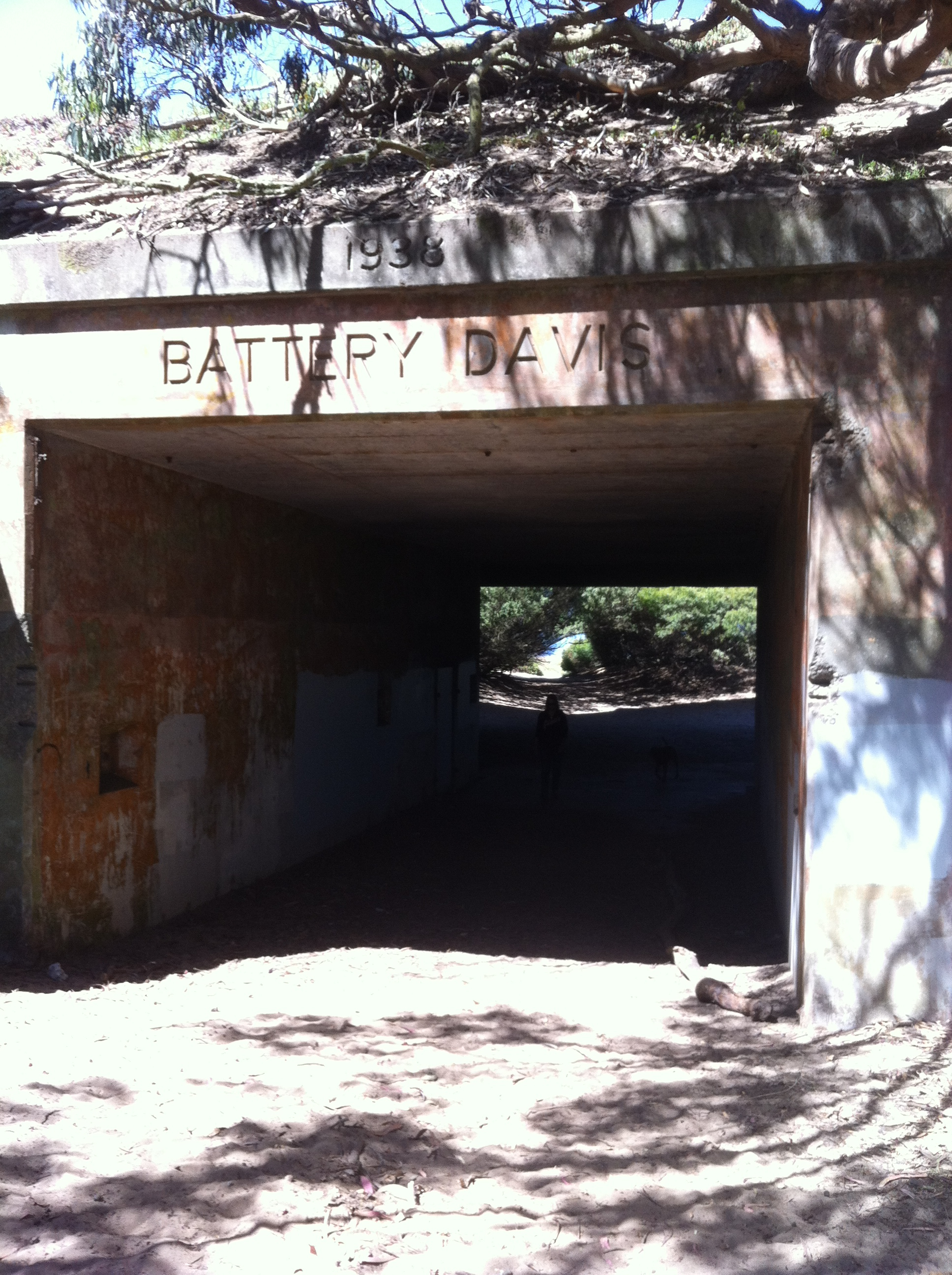
Disaster averted, I took my canine pal, DeeDee, to Fort Funston, built in the late 1930s as an artillery battery to protect San Francisco Bay from Japanese invasion, now a dog park and hang glider takeoff spot. It’s one of the few safe places the city’s dog owners can let their dogs run offleash and free, and a wonderful place to enjoy spectacular views of the Pacific Ocean. [Great ocean views were once critical, I understand, for artillery batteries.]

Not a cloud in the sky, the sun was warm, the breeze off the Pacific refreshing. A glorious first day of summer, the so-called longest day of the year in the Northern Hemisphere.

We, my spouse and I, once visited the Orkneys, islands north of Scotland, during the summer. Even after midnight, it never got truly dark. As I waxed poetic about the islands’ stunning beauty, a native reminded me that, 6 months from then, in the dead of winter, it would never be truly light; the sun doesn’t really rise, the place stays in perpetual twilight.

Yeah, thanks anyway. I believe I’ll just stay right where I am, closer to the Equator.

Catch

It was an uncharacteristically warm and sunny early evening, so my son and I grabbed our mitts and ran to the nearby park for a catch. For those readers unfamiliar, having a catch is a generations-old ritual of American life; at its simplest level, it is the activity of throwing a baseball back and forth between two people.

If you’ve seen the film ‘Field of Dreams,’ you may have a sense of the importance of this particular ritual to parent-child, (still primarily father-son) relations and bonding in our culture. Having a catch provides both physical proximity and mental space, which allows for conversation about issues that might never get addressed in the closer and more intimate setting of, say, the dining table.

On early summer evenings, like this one, my own dad would get home from work and we’d still have at least an hour of light left for a catch at the playground across the street. He’d like moving around after being at his desk all day but he’d also always take the chance for a cigar, which he wasn’t allowed at home.

Me? I don’t smoke, I just throw. Having a catch is enjoyable and restorative enough for me without any chemical enhancements.

You can’t simultaneously have a catch and think about the action of throwing. Think about throwing and, it never fails, the ball goes awry. Let the ball go freely from your hand, and all is well. Just one of the many paradoxes of baseball.

We, my son and I, have gotten to the point where his throws are harder than mine. Despite his lean frame, he’s got a cannon for an arm and his throws pop the leather of my glove with a snap that echoes around the park. Sounds great. His growing arm strength and control feels great to me too, on so many levels.

Greece Decides

A sigh, but not one entirely of relief.

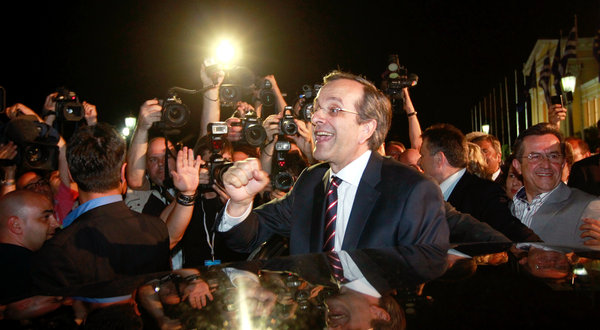
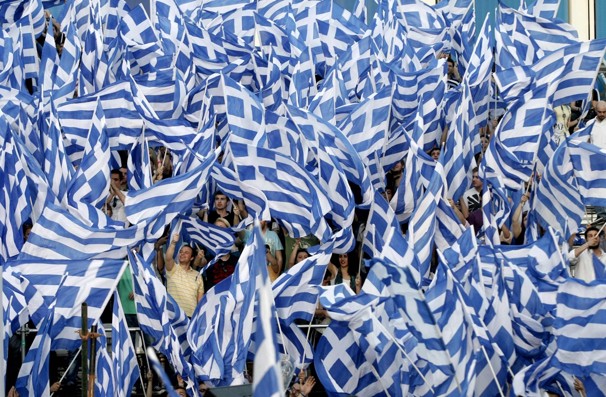
The much-anticipated return to the polls happened in Greece this past weekend, and the global game of economic chicken is over for the moment.

The result of the nation’s second election in a little over a month was a very narrow victory for one of Greece’s traditional political parties, the conservative and pro-bailout/EURO/austerity New Democracy (ND) party. Assuming ND can successfully form a government, this would seem to indicate that Greece will, for now, stay within the boundaries of a heavy-handed, German-dictated austerity agreement and stay within the Eurozone.

Yesterday’s election gives hope to many, including those working in the world’s financial markets, and rips it cleanly and painfully away from others, like ordinary working Greeks, who can now fully expect to pay for their misplaced faith in international establishments, corporate elites and even their own elected leaders.

One important lesson I hope my beloved Greek brothers and sisters have learned through this recent experience: political leaders, whether democratically elected or not, cannot be trusted to fulfill their campaign promises.  I recognize that I am a virtually complete cynic when it comes to this, but my own considerable experience amply supports this conclusion.

The Greek people, that is to say, the real, hard-working, family-oriented, open-hearted Greek people, who were sold blue-sky and puffy-cloud, joy-everlasting, land-of-milk-and-honey fictions about their participation in the Eurozone have been handed the bill for a banquet they were never invited to attend and, for which, their succeeding generations will be left to slave.

So, for now, the world has escaped the feared tipping over of the first Eurozone domino. I’d say it’s scant cause for celebration.

For All the Greek Marbles

On Sunday, June 17, Greeks will vote for the second time in about a month.

The last national election results seemed almost humorously irrational to the outside world; for example, putting both socialists and neo-Nazis into parliamentary seats. It wasn’t, of course, either funny or irrational from the perspective of the Greek people, who felt themselves lied to by their own political and business leaders and by global financial interests, leaving them with a burning anger and the unpaid bill for quite a spending party.

After the May elections, no party could form a government, so the nation will go to the polls again.

But there’s no laughing this time around. Not anywhere.

The stakes are quite serious, indeed. Greeks must decide whether they’ll stay in the Eurozone and, if so, who will bear the burden. Markets are trembling and tough talk from some quarters, especially among Europe’s so-called leaders, has done nothing of benefit to anyone. Financial analysts, governments and politicians everywhere are watching closely what the Greek people will decide about their future – stay or go, accept Eurozone-mandated austerity measures, radically change the nature of Greek social programs. In any case, there will be worldwide ripple effects, in addition to perhaps seismic changes within Greece itself.

Austria’s foreign minister, Maria Fekter, put the question with characteristic starkness and gratuitous paternalism, what some see as a direct threat: “Greece will not receive any more economic aid if the election on 17 June results in a government that refuses to keep to the terms of the memorandum [prior agreement about bailout conditions].”

Will Greeks express a clear direction? Will they start the domino-like disintegration of the Euro? Will they provide an example other European countries will follow?

Sunday’s election in the birthplace of democracy will tell.

On the Road Again, Nelson!

I used to drive with the window down, my left arm resting on the door. Never had air conditioning in those days. Summer or winter, the rolled down window was all there was.

Always had a cassette player, though, so I could blast the Doobie Brothers, Jimmy Buffet, the Crusaders, Weather Report, Bonnie Raitt, or whatever else I was listening to at the time and sing along.

I hear your voice everywhere

It’s echoes of love

Making me look back over my shoulder

Echoes of love are started all over.

Something like 30 years ago, I had a teeny, white Renault. Never went very fast, even going downhill. Got blown around a lot by big trucks on the freeway. In their rearview mirrors, I could see the drivers laughing as they passed. I guess they didn’t see many Renaults in North Carolina. Could also have been because I had a license plate that said “SLUG.” Or maybe it was because you didn’t often see big guys like me driving little cars they could barely fit into.

I suppose I should have given them the benefit of the doubt.

One winter night in Philadelphia, I was stopped at a red light. The guy next to me motioned for me to roll down my window. He leaned over and yelled, “Hey, brother, they build that car around you?”

The light turned green and he took off laughing.

It was a honey of a car, though. Still maybe the best I’ve ever had. Reliable. Great gas milage. Easy to work on. Once replaced the gas tank by myself; wouldn’t dream of even trying it with my current car. Couldn’t go fast, but it did make it cross-country more than once, packed floor to ceiling with all my worldly possessions. Truth is, I’d probably still have it if it wasn’t totaled by a drunk driver one night. I saw it for the last time, there amidst the auto ghosts on Pier 40, where they towed it after the accident.

Folded up like a little, white, French accordion, my hand to God.

Pledging Allegiance

Many years ago, I met a guy about my age who was visiting mutual friends in the US from South Africa. He was studying architecture and we walked around Washington, DC together, pretty much looking at statues and buildings. He remarked that, compared to the other world capitals he’d visited, DC’s buildings were the most self-consciously monumental, or something like that.

He asked me why I thought that might be true.

And I said I thought it was because, relative to European cities, we had such a short history, we needed to create purposefully the gravitas their capitals had by virtue of their longevity. “So, it’s to cover over your insecurity, then?” he asked. “Yeah, basically.” I replied.

Reminds me of the time I visited the farm in Greece that’s been owned by my family for generations. While showing us around, my great-uncle George pointed at an old shed and said with a teasing laugh, “See that building? It’s older than your whole country.”

In 1892, as part of America’s public school celebration of the 400th anniversary of Columbus’ landing in the West Indies, Francis Bellamy, an American Christian Socialist, wrote the first pledge of allegiance and it went like this:

I pledge allegiance to my Flag and the Republic for which it stands, one nation indivisible, with liberty and justice for all.

The pledge wasn’t adopted as any sort of nationwide standard until 1942. Since that time, the pledge of allegiance has undergone changes. The most significant being the addition of the phrase “under God,” as a contrast to “Godless communism,” in 1954.

The pledge, as most say it today, goes like this:

I pledge allegiance to the flag of the United States of America, and to the republic for which it stands, one nation under God, indivisible, with liberty and justice for all.

The salute has also changed since the early days. The earliest version I could find appears in the top photo (above). A bizarre Nazi-esque salute was used in the 1940s (below). Today, while those in uniform hold a standard salute, the United States Flag Code calls for civilians to hold their right hand over the heart.

One might well ask why we Americans pledge our allegiance to a flag to begin with. I mean, specifically, why a flag? Why don’t we pledge our allegiance to the nation? The republic itself? Our form of government? Each other? Certain principles?

Why a flag? A flag is a tangible thing. It is just dyed cloth. Thinking people can’t really pledge their allegiance to a piece of cloth.

The flag, and not some more suitable abstract concept, was purposefully chosen by Bellamy as the object of our collective allegiance, because in 1892, the country, then less than 30 years after the Civil War, was deeply divided over very significant matters. Bellamy wanted to highlight a certain set of commonly held American principles without explicitly listing them because there wasn’t the consensus on them necessary to support a common list. One example: he initially included the term “equality” in his pledge but decided against it because the country wasn’t fully behind equality for people of all races.

I believe we still use pledge to a flag today for much the same reason. If we pledged to a certain set of commonly-held principles, what would those be? These days, I can’t imagine reaching any level of national consensus on much. So, we’ll continue this bizarre practice of swearing our loyalty to cloth. And yet, because of our national insecurities, of which there are legion, we cling with a death-grip to anachronisms like the pledge, and simultaneously use it like a war club to attack those who don’t publicly exhibit adequate patriotism.

The pledge of allegiance has become little more than the equivalent of the red, white and blue Dacron bunting that gets unpacked on holidays to festoon sales at shopping malls. I suggest we scrap it now and have a real national dialog on what matters: what it really means to be an American and what we stand for as a people.

I’d pledge allegiance to that.

Poem for a Sunday

Sunday Morning

Down the road someone is practising scales,
The notes like little fishes vanish with a wink of tails,
Man’s heart expands to tinker with his car
For this is Sunday morning, Fate’s great bazaar;
Regard these means as ends, concentrate on this Now,

And you may grow to music or drive beyond Hindhead anyhow,
Take corners on two wheels until you go so fast
That you can clutch a fringe or two of the windy past,
That you can abstract this day and make it to the week of time
A small eternity, a sonnet self-contained in rhyme.

But listen, up the road, something gulps, the church spire
Open its eight bells out, skulls’ mouths which will not tire
To tell how there is no music or movement which secures
Escape from the weekday time. Which deadens and endures.

  • Louis MacNeice 


Know Your Neighbors

I grew up in the 1960s, a typical kid in one of San Francisco’s many typically middle class neighborhoods. Corner grocery stores, kids listening to baseball on the radio, playground sports, dads at work, moms at home.

We knew most of the families in our part of the neighborhood, some by sight, some more intimately. Most of the kids in my neighborhood, and there were lots of kids, went to either our nearby public school or to the local parish school. After 12 years of school together, we got to know those families very well. Neighbors without kids were mostly kept on a friendly “good morning” basis.

We had one neighbor named Anton Lavey. His daughter Karla was a classmate of Mike, my older brother, but because she didn’t play sports with us, we didn’t know her very well. Like a lot of our neighbors, Lavey was fairly quiet, maintained his home fairly well and kept mostly to his own business. Now, there were a few quirks, but that could be said of most of our neighbors. Lavey’s particular quirks, however, were, relative to our other neighbors, somewhat more intense.

For one thing, he had a pet lion. Yes, an actual, grown-up, although trained and domesticated, lion. He’d walk it around on a leash from time to time.

Lavey also had a clean-shaved head in an era when such things weren’t as common as no-fat decaf lattes. His goatee was trimmed and pointy. He always wore black; head-to-toe black. Sometimes, he’d even wear a black cape, lined in crimson red. His house was black, from the walls to the front gate to the window frames.

His picture would be in the newspapers or on local TV every once in a while, as one could imagine any hometown eccentric’s would.

Oh, I guess I forgot to mention that he also founded the Church of Satan. Yeah, that was our neighbor, Anton Lavey, the High Priest of Satan. Before he died, in 1997, he was visited by a very long line of pilgrims who came to his house from across the globe; people from Marilyn Manson to US presidential descendant Chester A. Arthur III.

Anton Lavey, just another guy wandering around my neighborhood, you know, with his pet lion on a leash.

Energy is Serious Business

As far as energy use, we Americans have had a pretty appalling record during the modern era. We use more energy per capita than any nation on earth; we are coming very very late to the conservation, renewables and sustainability party. And Republican candidates for president have lately provided no signs of easing off of their “drill, baby, drill,” use-not-save, red-meat mentality.

A recent survey by the AP-NORC Center for Public Affairs Research, funded by the Joyce Foundation might show some cause for optimism. The AP reports that:

“…energy, especially in a weak economy, is prominently on people’s minds — and may explain why it’s being talked about in the presidential campaign. Nearly 8 in 10 called energy deeply important to them, trumping concerns about the federal deficit and the environment.”

If true, is this the sign of a positive change in Americans’ consciousness or just a pre-summer, pre-election blip? It’s hard to know, but I’ll remain skeptical as long as I continue to see idiots like this (see below) on the road.

[Thanks to The Bliss Index for posting this photo, as a joke. Hahaha. A truck spewing toxic chemicals into the environment for our kids to breathe. Really funny. Get it?]