This Post Is Not (Just) About Sports

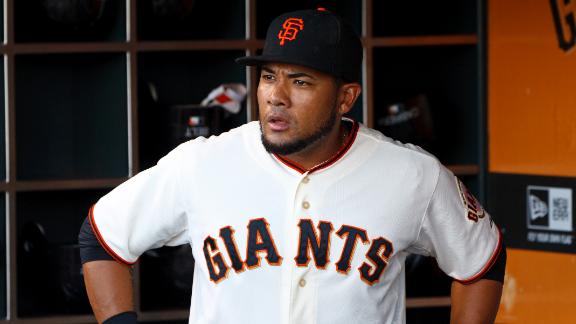
If you know or care anything about baseball, professional sports, or the San Francisco Giants, if you’ve watched the news or read a newspaper in the last day, if you pay attention to issues like the use of performance enhancing drugs, you already know about Melky Cabrera.

For those who don’t, here’s the 30-second version:

Melky Cabrera is a professional baseball player for the San Francisco Giants. He was having a stellar year, leading the National League in hits and being selected the Most Valuable Player in professional baseball’s all-star game earlier this summer. Yesterday, the league suspended him for taking performance enhancing drugs, a clear violation of league policy. As a result, during a particularly critical moment in the season, his team will be without his services.

Simple, right? Cabrera cheated, got caught, pays the consequences.

Not so simple, as it turns out.

His teammates pay a pretty steep price for trusting him. They go into their final drive for the pennant (trying to win their league’s championship) without a big piece of their team. In interviews with other Giants, you could see the betrayal on their faces, in their words and halting speech.

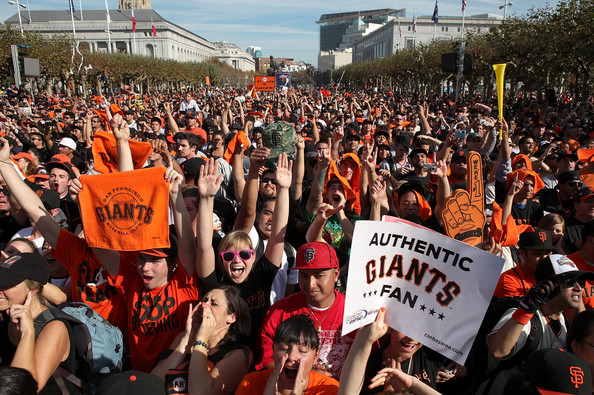
Fans, too, have every right to their anger and disappointment. The team itself? Sure. Vendors, stores selling Giants merchandise, restaurants and bars around the park? Yes, them too.

Turns out, Cabrera’s decision to use banned drugs was anything but personal. His deliberate cheating affected a great many people.

And here’s why this is not (just) a sports story. We have, in recent times, seen many examples of public figures choosing to engage in self-damaging behavior that causes widespread ‘collateral damage’ as well. Sandusky/Paterno/Penn State is simply the latest and best known example in a very long and very sad history.

My professional life involves helping people and institutions in moments like these. I have seen firsthand the damage people can leave in their wakes, sometimes quite blithely. Melky Cabrera is a successful professional athlete, so we can watch the pain he’s inflicted on others in the newspapers, on television and playing fields.

Other cheaters do their damage in darker, quieter places.
Overpass Prayers

The other day, a little after lunchtime, I happened to stop by the interstate near my house, just to make a couple of phone calls and send off a few emails. As usual, traffic was heavy, loud and fast. It was all I could do to concentrate for all the engine noise and honking.

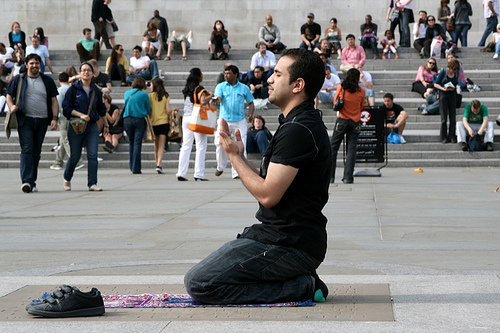
Out of the corner of my eye, I saw a man with a yoga mat rolled under his arm walking down the grassy strip that outlined the freeway off ramp. He went down a ways then stopped abruptly. He unrolled his mat and turned to face the noisy traffic below.

Then, and I recognized the characteristic movements at once, he began to pray. He was an observant Muslim and it was time for the daily Zuhr prayer. He had oriented himself more or less facing east, interstate traffic be damned.

I watched until he concluded, rolled his mat, walked back up the ramp and out of my view.  Seeing him creating his own sacred space in the midst of our society’s secular noise reminded me very much of the many business-suited people I’d see walking the labyrinth at lunch hour when I was on the staff of San Francisco’s Grace Cathedral.

No matter which particular traditions of practice we follow, if any at all, it would be a much different (i.e., better) world if we all set a few moments aside in our busy, hectic and noisy days for prayer, meditation, or even just conscious self-reflection.

Not What I Heard

The soundtrack of my young life went something like this: my mother played classical pieces on the living room piano, my dad played Sinatra and Johnny Cash on the Hi-Fi, my brother played the Beatles and the Rolling Stones on his transistor radio.

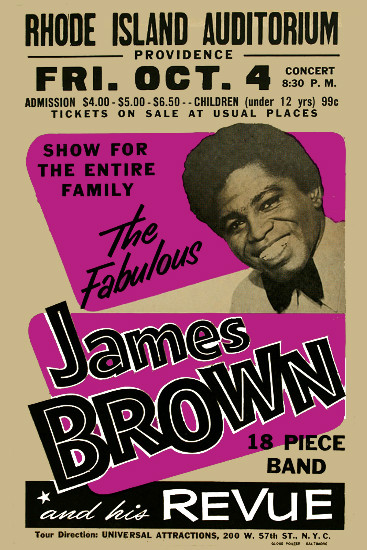
I try to remember that personal context thinking of the day (I was around 10 years old) when my friend Anthony brought a new album to the clubhouse of our neighborhood playground. He said to me, in dead earnest, “I know this isn’t what you listen to at home but you have to hear it.” And with that titillating introduction, he pulled James Brown’s ‘Cold Sweat’ out of the sleeve, itself looking strange and unfamiliar to me, and placed it on the playground’s antique record player.

What happened next isn’t entirely clear to me now, many years later, but when the ungodly-long (it was over 7 minutes) song ended, I knew something buried deep inside me had been released. I thought I knew music before hearing James Brown but this was something I’d never heard before; I’d never ever heard anything remotely like it. My wee 10-year-old brain was well and duly blown, and blown for good. When, sometime later, I finally saw Brown perform in ‘The T.A.M.I. Show,’ a concert film, a true happening of cosmic scale, I sat slack-jawed throughout. Not only was his music completely different than anything I’d heard before, he moved in ways I’d never seen.

My family recently gave me ‘The One,’ a brilliant biography of James Brown by RJ Smith and I inhaled it practically overnight. The New York Times review is here. It made me remember what I felt when I first heard his music and it made me appreciate or, more properly, re-appreciate just how revolutionary a figure he was. And to say I loved the book is in no way to sugar-coat Brown’s street-tough life, personal inadequacies, or thorny personality.

James Brown lived hard and righteously pissed off nearly every single person he ever met. That said and understood, he laid a foundation for all that followed him. If you don’t know James Brown, his music and performance, do yourself a favor and discover him now. If you do know him, get Smith’s book; it will be a revelation.

You’re welcome.

Another Pilgrim

The other night, along with many thousands of other visitors, we found ourselves on the Mall in Washington, DC.

It had been a sweltering day in the capital and many, I assume, were outside to escape the heat in cramped apartments and hotel rooms. But most, myself included, were there for other, more site-specific reasons.

The Vietnam Memorial, a black granite gash carved into the cool grass of the mall, attracted quite a lot of visitors for that late hour.  Most displayed that singular combination of excitement, appreciation and respect I’ve seen there all the many times I’ve visited.

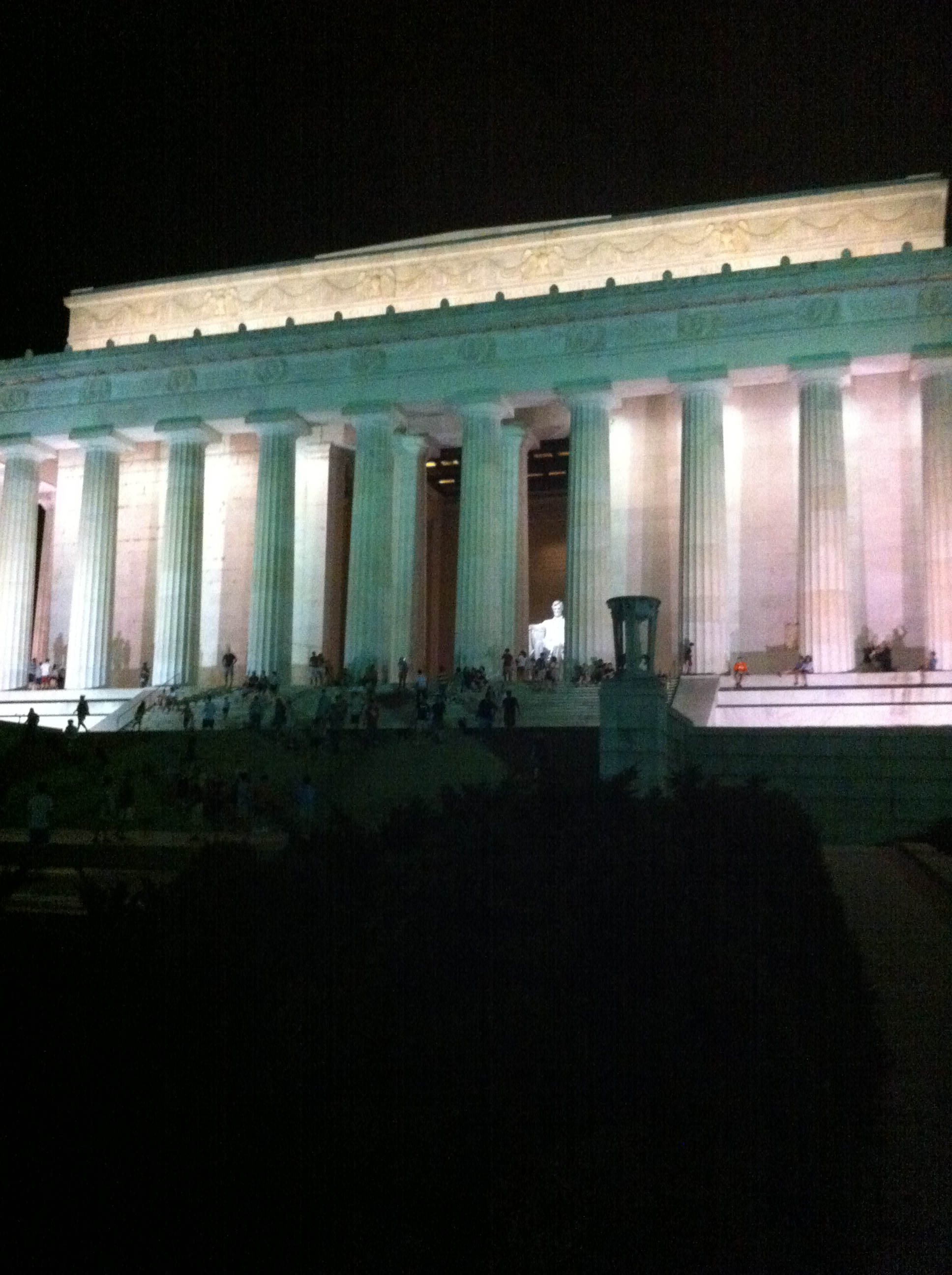
But it was the Lincoln Memorial that had, by far, the largest crowds. The enormous white statue of the martyred president sits alone, with the exception of his own words, high in a neo-classically Greek temple, itself perched atop many many stairs. The path upward to see Lincoln is extraordinary, the view of Washington from his feet, amazing. His face looks down at his visitors, not with fatherly kindness, nor happiness, but stern judgment.

There is no mistaking the intended effect: awe. We are showing near-sacred reverence for someone we placed in deliberately shaky control of our nation’s future during a time of unprecedented challenge. And then, just at the moment of the Union’s and his victory, one of our fellow citizens murdered him. Along with the battlefield at Gettysburg, the Lincoln Memorial may be our secular nation’s only great temple.

Few leaders anywhere in the world have such memorials.

Up those many steps, I saw the climb of individuals, families, other groups, large and small. I heard voices speaking in many languages; some I understood, some I recognized, others were completely foreign to me. No matter the language, on the faces and in the gestures, I could read the respect of pilgrims to the site.

People come from all over the earth with deep and sincere appreciation to visit this place of tribute to the man who preserved the union during our greatest crisis.

Is it at all possible to find, to recognize, to appreciate that level of greatness in our country today? Are we all pilgrims to dead American characteristics? Are we all visiting Lincoln’s memorial like schoolkids looking at reconstructions of the dinosaurs?