Pledging Allegiance

Many years ago, I met a guy about my age who was visiting mutual friends in the US from South Africa. He was studying architecture and we walked around Washington, DC together, pretty much looking at statues and buildings. He remarked that, compared to the other world capitals he’d visited, DC’s buildings were the most self-consciously monumental, or something like that.

He asked me why I thought that might be true.

And I said I thought it was because, relative to European cities, we had such a short history, we needed to create purposefully the gravitas their capitals had by virtue of their longevity. “So, it’s to cover over your insecurity, then?” he asked. “Yeah, basically.” I replied.

Reminds me of the time I visited the farm in Greece that’s been owned by my family for generations. While showing us around, my great-uncle George pointed at an old shed and said with a teasing laugh, “See that building? It’s older than your whole country.”

In 1892, as part of America’s public school celebration of the 400th anniversary of Columbus’ landing in the West Indies, Francis Bellamy, an American Christian Socialist, wrote the first pledge of allegiance and it went like this:

I pledge allegiance to my Flag and the Republic for which it stands, one nation indivisible, with liberty and justice for all.

The pledge wasn’t adopted as any sort of nationwide standard until 1942. Since that time, the pledge of allegiance has undergone changes. The most significant being the addition of the phrase “under God,” as a contrast to “Godless communism,” in 1954.

The pledge, as most say it today, goes like this:

I pledge allegiance to the flag of the United States of America, and to the republic for which it stands, one nation under God, indivisible, with liberty and justice for all.

The salute has also changed since the early days. The earliest version I could find appears in the top photo (above). A bizarre Nazi-esque salute was used in the 1940s (below). Today, while those in uniform hold a standard salute, the United States Flag Code calls for civilians to hold their right hand over the heart.

One might well ask why we Americans pledge our allegiance to a flag to begin with. I mean, specifically, why a flag? Why don’t we pledge our allegiance to the nation? The republic itself? Our form of government? Each other? Certain principles?

Why a flag? A flag is a tangible thing. It is just dyed cloth. Thinking people can’t really pledge their allegiance to a piece of cloth.

The flag, and not some more suitable abstract concept, was purposefully chosen by Bellamy as the object of our collective allegiance, because in 1892, the country, then less than 30 years after the Civil War, was deeply divided over very significant matters. Bellamy wanted to highlight a certain set of commonly held American principles without explicitly listing them because there wasn’t the consensus on them necessary to support a common list. One example: he initially included the term “equality” in his pledge but decided against it because the country wasn’t fully behind equality for people of all races.

I believe we still use pledge to a flag today for much the same reason. If we pledged to a certain set of commonly-held principles, what would those be? These days, I can’t imagine reaching any level of national consensus on much. So, we’ll continue this bizarre practice of swearing our loyalty to cloth. And yet, because of our national insecurities, of which there are legion, we cling with a death-grip to anachronisms like the pledge, and simultaneously use it like a war club to attack those who don’t publicly exhibit adequate patriotism.

The pledge of allegiance has become little more than the equivalent of the red, white and blue Dacron bunting that gets unpacked on holidays to festoon sales at shopping malls. I suggest we scrap it now and have a real national dialog on what matters: what it really means to be an American and what we stand for as a people.

I’d pledge allegiance to that.

Poem for a Sunday

Sunday Morning

Down the road someone is practising scales,
The notes like little fishes vanish with a wink of tails,
Man’s heart expands to tinker with his car
For this is Sunday morning, Fate’s great bazaar;
Regard these means as ends, concentrate on this Now,

And you may grow to music or drive beyond Hindhead anyhow,
Take corners on two wheels until you go so fast
That you can clutch a fringe or two of the windy past,
That you can abstract this day and make it to the week of time
A small eternity, a sonnet self-contained in rhyme.

But listen, up the road, something gulps, the church spire
Open its eight bells out, skulls’ mouths which will not tire
To tell how there is no music or movement which secures
Escape from the weekday time. Which deadens and endures.

  • Louis MacNeice 


Know Your Neighbors

I grew up in the 1960s, a typical kid in one of San Francisco’s many typically middle class neighborhoods. Corner grocery stores, kids listening to baseball on the radio, playground sports, dads at work, moms at home.

We knew most of the families in our part of the neighborhood, some by sight, some more intimately. Most of the kids in my neighborhood, and there were lots of kids, went to either our nearby public school or to the local parish school. After 12 years of school together, we got to know those families very well. Neighbors without kids were mostly kept on a friendly “good morning” basis.

We had one neighbor named Anton Lavey. His daughter Karla was a classmate of Mike, my older brother, but because she didn’t play sports with us, we didn’t know her very well. Like a lot of our neighbors, Lavey was fairly quiet, maintained his home fairly well and kept mostly to his own business. Now, there were a few quirks, but that could be said of most of our neighbors. Lavey’s particular quirks, however, were, relative to our other neighbors, somewhat more intense.

For one thing, he had a pet lion. Yes, an actual, grown-up, although trained and domesticated, lion. He’d walk it around on a leash from time to time.

Lavey also had a clean-shaved head in an era when such things weren’t as common as no-fat decaf lattes. His goatee was trimmed and pointy. He always wore black; head-to-toe black. Sometimes, he’d even wear a black cape, lined in crimson red. His house was black, from the walls to the front gate to the window frames.

His picture would be in the newspapers or on local TV every once in a while, as one could imagine any hometown eccentric’s would.

Oh, I guess I forgot to mention that he also founded the Church of Satan. Yeah, that was our neighbor, Anton Lavey, the High Priest of Satan. Before he died, in 1997, he was visited by a very long line of pilgrims who came to his house from across the globe; people from Marilyn Manson to US presidential descendant Chester A. Arthur III.

Anton Lavey, just another guy wandering around my neighborhood, you know, with his pet lion on a leash.

Energy is Serious Business

As far as energy use, we Americans have had a pretty appalling record during the modern era. We use more energy per capita than any nation on earth; we are coming very very late to the conservation, renewables and sustainability party. And Republican candidates for president have lately provided no signs of easing off of their “drill, baby, drill,” use-not-save, red-meat mentality.

A recent survey by the AP-NORC Center for Public Affairs Research, funded by the Joyce Foundation might show some cause for optimism. The AP reports that:

“…energy, especially in a weak economy, is prominently on people’s minds — and may explain why it’s being talked about in the presidential campaign. Nearly 8 in 10 called energy deeply important to them, trumping concerns about the federal deficit and the environment.”

If true, is this the sign of a positive change in Americans’ consciousness or just a pre-summer, pre-election blip? It’s hard to know, but I’ll remain skeptical as long as I continue to see idiots like this (see below) on the road.

[Thanks to The Bliss Index for posting this photo, as a joke. Hahaha. A truck spewing toxic chemicals into the environment for our kids to breathe. Really funny. Get it?]

Nuclear Bullsh*t

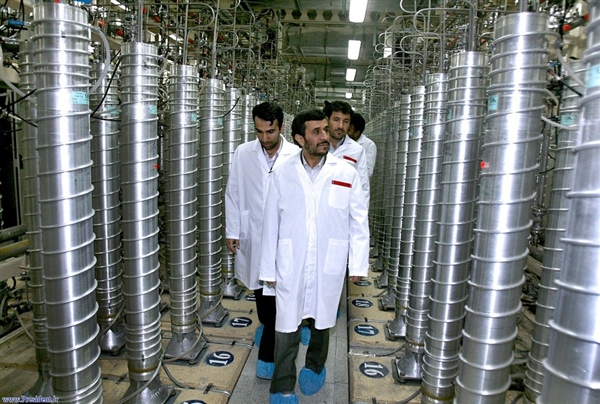
Not long ago, as reported by ABC News, Republican presidential candidate Mitt Romney criticized his opponent, president Barack Obama, for not doing enough to stop the Iranian development of nuclear weapons.

“If Barack Obama gets re-elected, Iran will have a nuclear weapon…and I’m not willing to allow your generation to have to worry about a threat from Iran or anyone else that nuclear material be used against Americans,” Romney said.

I’ve written previously about the hypocrisy of much political campaign talk about Iran’s nuclear weapons program and the ability of this (or any) American president to influence its eventual (and inevitable) outcome. I’ll say it again: short of bombing it to the Stone Age (which no one can seriously advocate), the American president can do nothing to prevent any other highly-motivated and highly-resourced country from developing nuclear weapons. The science is known, the materials and technology are available, the expertise exists. Sanctions (economic, trade, or otherwise), diplomatic action, even targeted military action will not prevent anything. These steps can only make nuclear weapon development take longer and be more costly, so, at best, temporarily forestall the inevitable.

So, Romney can say he won’t “allow” Iran to have nuclear weapons all he wants; it’s merely campaign ‘sound and fury.’ And it’s mighty telling that, when pressed, Romney hasn’t been able to articulate a concrete path toward the stance he suggests Obama can’t deliver. Know why? The path doesn’t, in fact, exist.

In this election season, can’t you at least be honest about that one little thing, Mitt?

Baseball Stories: A Bittersweet Goodbye

Just this past weekend, we went to San Francisco’s AT&T Park to see the hometown baseball team, the Giants, play the Chicago Cubs. And we happened to sit in front of a fairly large group of people who all wore matching t-shirts. Not orange-and-black Giants’ shirts, or even Cubs’ shirts, but custom t-shirts bearing the name and photograph of the same man.

As any true baseball fan knows, there can be real camaraderie in the stands. People tend to talk to each other, find out where others are from, joke, discuss and even (mostly civilly) argue about the team and the game. But because I was with my family, and because I was keeping score, and because it was a gorgeous day and an action-packed close game, I didn’t give our neighbors, or their matching shirts, more than a second’s thought. On a cold night, or during a slow game I might well have.

After the game was over, many in our section took a few moments to savor the Giants’ victory and talk a bit. I took a closer look at those t-shirts and saw what appeared to be dates of birth and death. A young man wearing the shirt noticed me looking, perhaps a bit too intently; I was a little embarrassed.

“Someone close to you?”

“My dad. He passed a couple of weeks ago.”

“I’m so sorry. I didn’t mean to be nosy.”

“He loved the Giants, so we decided to celebrate his life at a game. He and I sat together right up there (pointing to the upper deck) for the World Series in 2010, so I put some of his ashes there. We’re going to put the rest in McCovey Cove (the little lagoon just outside the ballpark) right now.”

“That’s beautiful, man.”

“Yeah, it really is.”

Just the thought of it made me choke up. This young man, bearing a portrait on his chest like a heraldic crest and carrying an urn, together with his family, went off to spread his father’s ashes in a place that meant something special to him in life. And as a lifelong Giants’ fan myself, I can’t think of a more fitting resting place or a more beautiful tribute.

Nerd Porn

There’s a new store in my neighborhood that sells comic books and all that comes with them these days: graphic novels, character action figures, overly-clever t-shirts, trading cards and supplies for fantasy games.

In my day, there weren’t any stores like this. We bought our comics at the corner drug store (there was a spinning rack right by the front door) and didn’t have any of the associated gift items that make up a lot of the comic market value now.

Today, comics are a huge industry. There are international conventions. There are spin-off graphic novels clearly intended for adults. Comic book characters are the basis, not just for fabulously successful stand-alone movies, but for mega-million dollar franchises of high-grossing movie series and international merchandising. Witness this year’s The Avengers, taken from the long-running Marvel Comic series, the new Batman movie, from the DC Comics’ hero, and Marvel’s SpiderMan film remake.

Part of the difference over time, of course, is that the intended comic audience has changed so substantially since the days when I first read them, during the so-called Silver Age of comics (mid-1950s to 1970). A look at comic conventions, like San Diego’s ComicCon, shows that these days, comics draw late-teens and young adults more than kids running weekly to their local drugstores.

In the end, I couldn’t resist walking into my new local comic store for a quick look. I found it filled with customers, all glasses-wearing, iPhone or iPad toting men in their early 20s. And the way they leafed through the books and stole oblique looks at the two comely young ladies working there reminded me less of my early days flipping through comics at the drug store than guys sneaking looks at the wares of the many adult stores in the Tenderloin.

Then it dawned on me, comics aren’t comics anymore; they’re nerd porn.

A Moment to Breathe

I am just back from a few days in nature. I have breathed clean, cool, fresh air. I have walked fair distances, done significant physical labor, (for the most part) stayed off my electronics. I have sat in grassy shade and had long conversations about really nothing of lasting consequence. I have watched the sun rise over the hills and dapple the leaves of coastal California’s native scrub oak, manzanita and madrone. I explored part of a creek that wound its way down a ravine to reach the mighty Pacific Ocean.

Even in a singularly beautiful natural environment, I still drank too much coffee. I didn’t eat or sleep well (Chaperoning 7th grade boys can do that to a person.).

A change of scenery like this, even a temporary one, can lift the spirits and boost thinking and creativity. There is a reason, after all, that so many retreat centers are located in the woods and so many fewer in center cities. Undistracted by the Internet, television and radio, the latest self-serving whipped-up political shit-storm, I was more relaxed and creative. I did, in fact, think deep thoughts.

On balance, then, it was an undeniably positive experience, although I’m still plenty happy to be back amongst my people.